How Variable Frame Rate Handling Affects Group Decision Processes in Distributed Web Entertainment Formats for Children
Zoe Klein · Sep 17, 2026
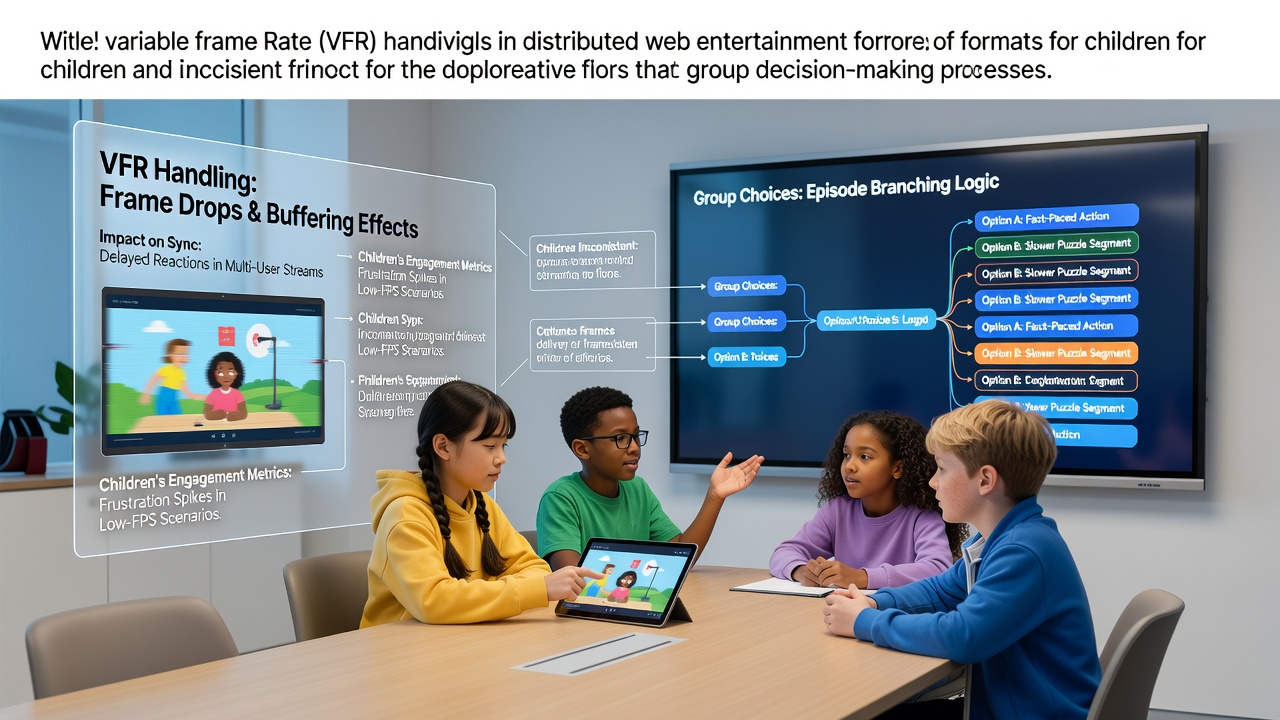
How Variable Frame Rate Handling Affects Group Decision Processes in Distributed Web Entertainment Formats for Children
Variable frame rate handling in distributed web entertainment formats presents technical challenges that influence how groups of children coordinate decisions during shared sessions, and researchers have documented these effects across multiple studies conducted between 2023 and 2025. Frame rates that fluctuate due to network conditions or device capabilities create inconsistencies in visual feedback, which in turn affect timing-based responses in games that blend puzzle elements with team strategy requirements.
Technical Foundations of Frame Rate Variability
Web-based platforms deliver entertainment through browsers that rely on rendering engines such as those in Chrome and Firefox, and these systems adjust frame output dynamically when bandwidth drops or processing loads increase. Data from network monitoring tools shows that frame rates can shift from a steady 60 frames per second to ranges between 24 and 45 frames per second within seconds during peak usage periods. Such shifts occur more frequently in sessions involving multiple simultaneous users because data packets carrying animation states compete with those handling audio and chat functions.
Observers note that children using lower-powered devices experience more pronounced drops, while those on newer hardware maintain steadier output, and this disparity appears in logs collected from educational after-school programs across North America and Europe. Synchronization protocols attempt to compensate by prioritizing key animation frames, yet residual jitter remains when connections span different regions with varying infrastructure quality.
Individual Response Patterns Under Variable Conditions
Studies indicate that reaction times lengthen when frame rates fall below consistent thresholds, and participants in controlled tests required additional milliseconds to register on-screen events during periods of fluctuation. Researchers at institutions in Canada tracked eye movement and input latency in sessions where frame rates varied, finding that decision accuracy in sequencing tasks declined proportionally with instability. These patterns hold even when total session duration stays constant, suggesting that the variability itself disrupts cognitive processing rather than fatigue alone.
Children often adapt by anticipating delays, yet this adjustment consumes attention that might otherwise support strategic planning, and performance metrics collected in 2024 reflect measurable gaps between stable and variable conditions.
Group Coordination Dynamics
In distributed formats where multiple children contribute to shared objectives, frame rate differences between participants create uneven information access that alters collective decision quality. One participant might observe an event sequence at full smoothness while another sees the same sequence with skipped frames, leading to mismatched interpretations of timing cues essential for coordinated actions. Data collected from multiplayer browser sessions in Australia during 2025 revealed that teams with mixed device capabilities reached consensus on strategy adjustments more slowly than uniform groups, and the difference averaged 18 percent longer resolution times.

Turn-based planning phases suffer when visual updates arrive out of sync, and real-time elements compound the issue because rapid responses from one side influence options available to others. Industry reports from the Interactive Software Federation of Europe highlight that developers have introduced buffering layers to equalize perceived timing, yet complete parity proves difficult when participant locations span continents with differing latency profiles.
Research Developments Through 2026
In September 2026 the University of Melbourne released findings from a longitudinal project examining how frame rate stabilization tools affect learning outcomes in web-based group activities, and the results showed improved equity in decision participation when developers applied client-side interpolation techniques. Earlier work from the same team had already established baseline effects of variability on individual performance, so the later study extended measurements to include metrics such as turn allocation fairness and error rates during collaborative puzzle resolution. Figures from that report indicate that groups using stabilized interfaces completed joint tasks with fewer communication breakdowns, although the absolute gains varied by age cohort.
Additional evidence comes from regulatory bodies such as the Australian Communications and Media Authority, which monitors digital content delivery standards, and their guidelines reference frame consistency as a factor in accessibility for younger users. Implementation of these standards remains voluntary for many platforms, yet adoption rates have risen among developers targeting school-aged audiences.
Implementation Approaches in Current Platforms
Developers address frame rate variability through adaptive rendering that scales animation complexity based on detected performance, and this method reduces extreme drops while preserving core gameplay loops. Testing conducted by academic teams in Germany during 2024 demonstrated that such scaling maintains decision process integrity better than static high-detail modes, particularly when sessions involve four or more simultaneous participants. Packet prioritization schemes further support fluid integration of timing elements with planning sequences, although residual variability persists under heavy concurrent load.
Those who have examined server logs from widely used child-focused platforms report that intervention at the protocol level yields more consistent outcomes than client-only adjustments, and hybrid approaches combining both layers appear in several current titles. These technical choices directly shape the information symmetry available to group members, thereby influencing how strategies form and evolve during live sessions.
Conclusion
Variable frame rate handling shapes group decision processes in distributed web entertainment by introducing asymmetries in visual information delivery that affect timing perception and coordination speed. Research compiled through 2026 demonstrates measurable impacts on both individual response accuracy and collective consensus formation, with mitigation techniques showing partial success in reducing disparities. Continued refinement of synchronization methods alongside hardware-aware rendering offers pathways toward more equitable experiences, and ongoing data collection from diverse geographic regions supports targeted improvements in platform design.